

Many people have been asking how I work. So I wrote the following outline.
Phases
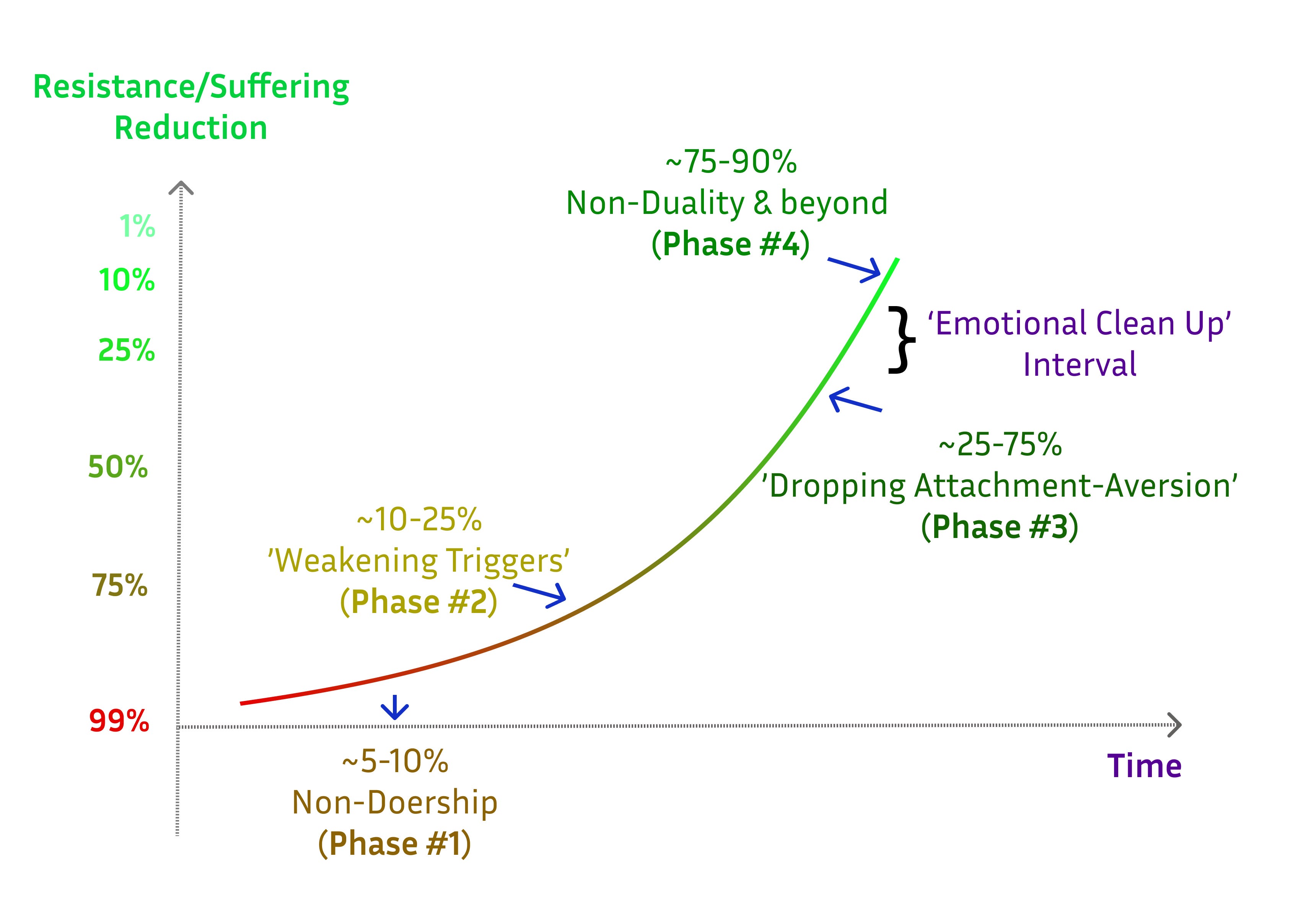
My work is divided in 4 phases, each providing a substantial reduction in suffering and an increase in unconditioned happiness.
Principles
Higher baseline over temporary peaks
It’s easy to have peak experiences. It’s hard to make them stick. The work we are doing will not focus on the temporary peaks, but on reducing the time spent triggered and/or resisting moment-to-moment experience. This leads to a much higher baseline of wellbeing.
Measuring Progress
Clear signs and checkpoints ensure you’re actually making progress. (Obvious, right? You’d be surprised). We also directly address the active situation in your day-to-day life, making it obvious to you when movement towards the right direction happens.
The point is to make myself irrelevant and replaceable with your own self-supporting ability.
“Micro-hits”
The process is designed to integrate into your ordinary life. Generally, shorter frames of 5-7 minutes a few times per day are more useful than one big chunk of >30 min, which you can do pretty much anytime it’s safe e.g. doing chores around the house, relaxing, cooking, in between meetings.
No ‘sitting meditation’ or ‘focusing on the breath’ needed.
Simplicity
The process itself is simple. It’s not easy the whole way. But it’s worth it.
Empiricism
The process is focused on a series of practical exercises you try yourself, from which beneficial effects gather up.
No dogma, woo or belief systems.
Who can benefit from this?
Most people are not blocked by information, as most materials are public, but by a combo of emotional buy-in and accountability. It’s also common to get distracted by events in daily life or being side-tracked by pre-existing avoidance patterns (for many people this especially can mean not returning to the process, maybe not ever).
Our work is meant to keep the feedback loop tight, reduce any confusion and support you until the shifts settle in and can sustain themselves.
My advice is to aim for Phase 3.
General FAQ
What kind of reactive situations do you work with?
Anxious and/or depressive patterns;
Grief and long-held regrets;
Doomscrolling and phone addiction patterns;
Procrastination and distraction from the important tasks in your life;
Any subject or category causing you suffering and/or unhappiness.
What do you mean by “suffering reduction”?
I mean reducing the pull and pull motion at life, of constantly resisting and not finding enjoyment in what is experienced currently. It’s also about not getting triggered or swayed by all the trivial things and even by the situations you assumed you were ‘too big to make a dent on’.
Time commitment
Around 40-60 hours total, across 3-4 months, for Phase 3 (my recommendation).
A weekly 60 minute session together and then practicing on your own.
Pre-existing experience
You don’t need to have previous experience, such as meditation or time spent in retreats.
Therapy?
Our work is not a substitute for psychotherapy or medical care in case you feel the need for it. The coaching process is about clearly seeing the reactive patterns, without buying into their narratives, and the suffering we put ourselves through, then drop it. Call it meta-cognition if you prefer.
Loss of ambition or drive
The goal is to reduce and drop unnecessary suffering so that your decision-making and action get better. People notice the opposite of ambition loss, a new zest to try new things and projects. Plus, the same things that you are trying to force yourself to work on now can be worked on with cleaner fuel while being happy in the process.